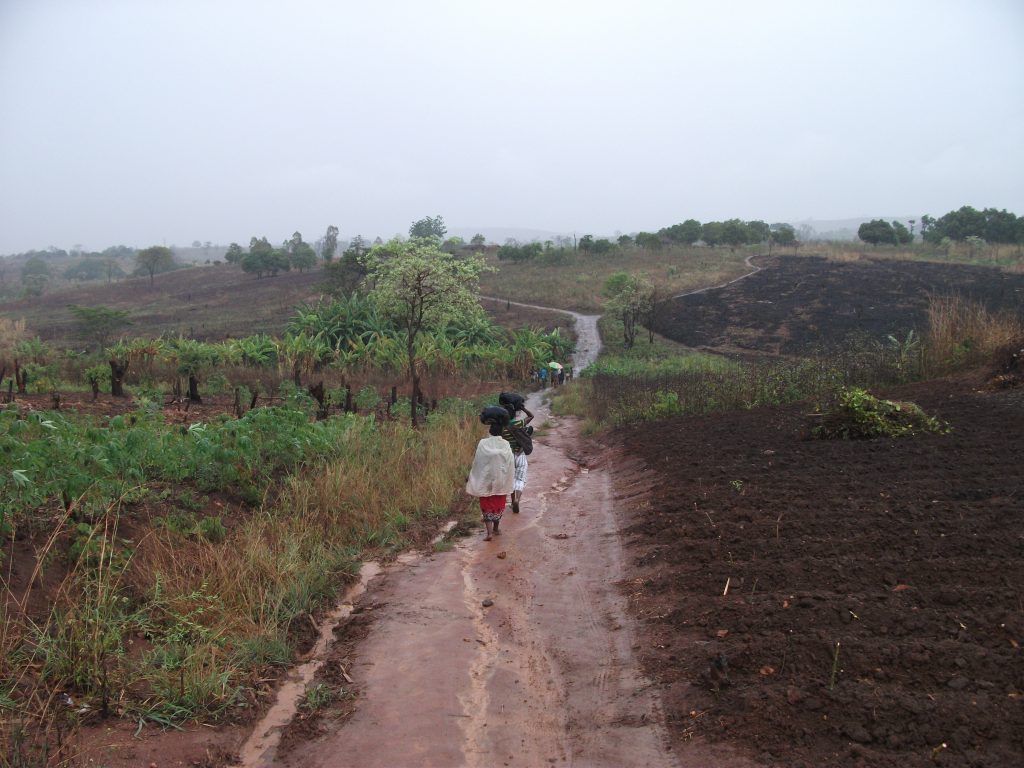
Zione Salamba from Tsabola Zambezi Evangelical Church is so thankful to receive her Bible in Chichewa. She can now read God’s Word whenever she wants. She can become rooted in the faith and guard against false teaching.
ZEC has many churches in rural parts of Malawi like Tsabola. These are places where there are poor roads, few buses and typically no electricity. Most people face extreme poverty. In a typical rural church with 100 or 150 members, usually no more than five to ten believers have their own Bible. The ZEC churches across the border in Chichewa-speaking parts of northern Mozambique can be even worse.
There are two big issues: access and cost. There are no shops in rural areas and transport to the nearest town or city is often unaffordable. A Bible costs just over £10, a huge amount for most people. zm’s subsidised Bible scheme aims to address these challenges. The mission buys the Bibles from the Bible Society of Malawi and delivers them to the recipients. They pay about £1.50 towards the cost. Unfortunately we never have enough funds to meet the enormous demand. But little by little we share what we are given with those who would like a Bible.
Would you like to help others like Zione to get access to God’s word? You can now give by text to provide a Bible in Chichewa for a believer in Malawi or northern Mozambique. Just text 10BIBLE to 70450 and we will receive your donation. You will also be given the opportunity to provide contact details if you wish us to claim Gift Aid.
A young man called Tim Lawrence got in touch with the mission last year. Tim has been studying Marine and Natural History Photography at Falmouth University. He worships at Slapton and Wappenham Evangelical Church in the Midlands and also at Falmouth Evangelical Church during his time at university. He was keen to come to Malawi last summer and wondered whether we could accommodate him. Not long afterwards Tim spent a month working alongside our partners in Malawi. One of the highlights of his visit was travelling on the MV Ilala to Likoma Island with the CFCM team. CFCM wrote in their prayer letter: “Thank God for the company and enthusiasm of UK student, Tim Lawrence, who patiently bore with the delays, and participated in all the activities, taking many photographs and leading morning devotions on Chizumulu. Pray that he will have been blessed with a greater understanding of life in Malawi and the importance of CFCM’s ministry”.
CFCM worker Joseph Jeke and Tim head to Likoma Island last summer Tim taking photos of Joseph Jeke during a seminar on Likoma Island Boarding the MV Ilala en route to Likoma Island (photo courtesy of Tim Lawrence)
Tim also took hundreds of wonderful photos during his time in Malawi which have been incredibly useful for the mission’s work. His pictures really bring the work of zm’s partners to life in a remarkable way.
Tim was back in Malawi again in March. He was staying in Blantyre during Cyclone Freddy and witnessed some of its horrors.
The horrific impact of Cyclone Freddy under Mount Soche in Blantyre (photo courtesy of Tim Lawrence)
This time he was planning to gather footage for a video about Children for Christ Ministry (CFCM) that he would submit as part of his university degree. During his stay he worked with CFCM to make this wonderful film about their ministry. We are delighted to be able to share “For the Land of Milk and Honey” below.
YouTube video
If you play this, Google may set cookies (privacy policy). We’ll set a cookie to log your consent for this and future YouTube videos.
We give thanks to God for Tim’s gifts and the way that he has shared them so generously with the mission and our partners. Thank you Tim! We pray that the Lord would guide and direct Tim in the coming months, as he discerns what he should do next in life.
We are sad to announce that our good friend and brother in Christ Ralph Gunn died peacefully on Monday 24th April. We are very thankful for the years in which he served the Lord through zambesi mission as an Honorary Representative. Ralph’s connection with zm came about through a series of God-ordained ‘co-incidences’. In the latter part of his career Ralph became Assistant Principal at Bell College (now the University of the West of Scotland). He was given responsibility for the college’s Malawi Millennium Project and travelled to Malawi on a number of occasions. During one of these visits he met Rev Bill Wilson who was then zm’s Field Director. Ralph and Bill both grew up in the same part of Scotland. Bill invited Ralph to stay with him and his wife Myra in Blantyre. After a minibus accident Ralph had an extraordinary experience. Although miraculously no one had been badly hurt, Ralph and the other occupants of the minibus were badly shaken and a crowd had gathered. A young Malawian girl came and clasped Ralph’s hand and said “God is good” – before disappearing into the crowd. This encounter stayed with Ralph and he felt that the Lord was calling him in some way to serve his brothers and sisters in Christ in Malawi.
Ralph attending a staff meeting in 2019 at York Baptist Church
After retirement Ralph applied to become an Honorary Representative for zm, a role that he started in 2008. He served in this voluntary capacity until the end of 2019. In addition to his visits to speak at churches, he also represented the mission at conferences: the Keswick Convention, Keswick in Buckie and Keswick in Motherwell. Ralph was a treasured member of our staff team. He took his role very seriously and was committed to it. He rarely missed our staff meetings in York and went out of his way to help others in their role. Travelling with Ralph would always be a pleasure. Mission Director Mike Beresford recalled travelling to Stonehaven to meet Ralph Gunn and Simon Chikwana. “It was a real treat to be picked up by Ralph in his rather nice Jaguar. From then on we travelled to Scottish churches in luxury”.
Ralph at Keswick in Motherwell in 2016 with visitors from MalawiRalph and Pastor Luckwell Mtima when he was ZEC General Secretary
Ralph’s times in Malawi hold many precious memories for us and our team in Malawi. Ralph’s culinary skills were put to the test when making a large bowl of porridge using the microwave in the guest house. A cry came from the kitchen “Oh Mike, the porridge has exploded!” Ralph was always prepared for an adventure. Twice he had barely set foot in Malawi before he was whisked away – on one occasion it was down to the Lower Shire (the very hottest part of Malawi) to look at a defunct windpump and be entertained by a crowd of villagers and orphans from an organisation that we were considering partnering with. Another time, we went straight off to the very under-developed north east Mozambique. We wanted to visit a certain church called Chindiwo ZEC. Ralph was driving. We reached a ‘bridge’ consisting of two very slippery and rotten looking tree trunks. Ralph concluded bluntly, “I’m not driving over that”, pointing at the tree trunks. The leaders from ZEC Mozambique responded: “the church is very far, unless we drive over we are not going to be able to visit it”. Ralph was not going to be swayed. He was wisely not keen on the idea of a vehicle getting stuck in a ravine in such a remote location. Then an elderly man came down the hill pushing his bicycle. A conversation ensued in Chichewa. The elderly man convinced everyone that the church was “pafupi” or not very far. So off we set in the drizzle, with the man rushing on ahead of us to alert the church. The church was not much in man’s eyes, but it was such a delight to join them. We rejoiced at the old man’s faithfulness and his enthusiasm to welcome visitors.
Walking to Chindiwo ZECChindiwo ZEC in Mozambique
Later on that trip Ralph’s driving skills were again put to good effect. Driving to Duya ZEC along a road designed for a motorbike, Ralph kept up a Stig-like pace along the rutted road. The vehicle had extra passengers inside, so Mission Director Mike Beresford had volunteered to climb into the luggage compartment (a normal travel option for Malawians or Mozambicans). After we arrived at the church thoroughly shaken up, Ralph said “Sorry Mike, I was just trying to keep up with the motorbike!”. Ralph did like to drive fast when he was able to.
Ralph with zm’s Project Officer Rose Chirwa at Duya ZEC in Mozambique
We were very thankful that Ralph was able to represent the mission at an award ceremony hosted by the Scotland Malawi Partnership, during which HRH The Princess Royal presented zm with an award following Cyclone Idai in 2019.
Ralph retired when his health started to deteriorate. Our opportunity to say thank you to him in person for his nearly 12 years’ service to the mission was thwarted by COVID – our leaving presentation to him took place via Zoom. We have missed Ralph’s dedication to the mission’s work and his prayerful commitment to our brothers and sisters in Christ in Malawi and northern Mozambique. We continued to pray for Ralph when his health grew worse and were very sad to hear about his death. But we were honoured to join his family and friends to give thanks for his life on Friday 5th May. In his usual way, Ralph had organised the order of service. His son Alan gave a tribute to Ralph’s life and his friend George Finnie spoke movingly from Scripture. Ralph’s other son David read a moving poem entitled Heaven that David himself had written some years previously. A very generous retiring collection was made towards the work of zambesi mission.
We give thanks to God for Ralph’s life. We pray for his wife Jean and for their sons Alan and David and their wider family. Farewell Ralph. We know to be with Christ is better by far, but nonetheless we grieve your loss and we will miss you. But we do not grieve like the rest of men who have no hope. For “we believe that Jesus died and rose again and so we believe that God will bring with Jesus those who have fallen asleep in Him” (1 Thessalonians 4: 14).
The rainy season in Malawi had been good throughout the growing season. The crops had been growing well, although the cost of fertiliser meant that yields were likely to be below par.
The maize crop around Malosa Zambezi Evangelical Church in February
All this changed on Sunday 12th March. Record-breaking Cyclone Freddy was one of only four cyclones that originated off the Australian coast and travelled across the Indian Ocean to the African continent. It has been the longest active cyclone in history and the only one that has recycled itself to hit Africa twice. On Sunday 12th March the BBC forecasted that up to 500mm of rain might fall.
Photo courtesy BBC
Whilst cyclones usually peter out before reaching the Shire highlands, this time the storm reached Blantyre. Some of its urban townships were hit by torrential rain followed by flash flooding and mudslides. This is the latest update from the Government of Malawi:
“As of 22nd March, the Government of Malawi’s Department of Disaster Management Affairs (DoDMA) report that as a result of Tropical Cyclone Freddy, to date in Malawi:
511 people have lost their lives.
Around 563,600 people (over 126,215 households) have been displaced.
533 people are missing.
1,066 are injured.
Public infrastructure including schools, health facilities, and district and main roads have been damaged in all affected districts. The most critical needs are:
The ongoing search and rescue operation for those trapped by flood waters and killed by mudslides.
Providing food and vital items to the thousands of people who have lost their homes and belongings and are now sheltering in over 500 camps”.
The devastation caused by Cyclone Freddy under Mount Soche in Blantyre (Photos courtesy Tim Lawrence)
The fatalities include 10 members of one family from Chilobwe Zambezi Evangelical Church in Blantyre, who were tragically swept away when torrential flash flooding engulfed the house that they were sleeping in. Please pray for all the families who have been affected and for those who have lost loved ones. Please will you also pray for those whose family members are still missing.
Many people are in temporary camps or sheltering in the ruins of their homes – please remember them as well in your prayers. We are passing on all gifts received for disaster relief to help our church partners who have been so badly affected and helping in whatever way we can. Please ask the Lord to grant our staff strength and resilience as they help as far as they are able. If you would like to donate towards the mission’s relief efforts you can give via our website. In the video below our Projects Officer Rose Chirwa and Administrator Mercy Carlos explain more.
YouTube video
If you play this, Google may set cookies (privacy policy). We’ll set a cookie to log your consent for this and future YouTube videos.
On Saturday 4th March, former zm mission worker Miss Jean Murray celebrated her 100th birthday. This article is an appreciation of her life thus far. We also remember with thanks another faithful servant from the same era, Mrs Elsie Stewart, who passed away peacefully on Wednesday 1st March aged 100 years.
Jean Murray was born in 1923. She grew up in Croydon, south London and went on to qualify as a nurse and then a midwife in local hospitals. In the late 1950s Jean was working in Cambridgeshire as a peripatetic midwife. There she had a colleague, Constance Biart, and they became close sisters in the Lord.
In 1960 Constance, or Con as she was known, went to Nyasaland, as it then was, as a missionary with zambesi mission. Jean visited her there for a holiday and Con challenged her to come and work there as there was a great need for medical staff in the mission’s health centres and rural hospital. By this time Jean was working in the Brighton area and going to Holland Road Baptist Church. Fairly soon after her return from Africa, the church held a missionary conference and Jean went forward in response to an appeal for people willing to go overseas to serve God.
Jean Murray with the mission’s cat Marmaduke in Malawi
Jean applied to zm and in 1965 went out to what was then the newly independent nation of Malawi. She was based first at zm’s HQ, called Mitsidi, on the edge of Blantyre, Malawi’s largest town. On the site was a school, church, printing press, offices, health centre and staff accommodation as well as fruit trees and crop growing areas. Whilst Jean loved being involved in everything, she was in greatest demand in the health centre running a day clinic, overseeing a pharmacy, going out to the villages around in a Land Rover she bought and of course delivering babies. In an emergency, nurses like Jean were called upon to do whatever they could, including pulling out teeth without anaesthetic. In 1969 she wrote an article for Polished Shaft, zm’s magazine for supporters, about the work with children at Mitsidi.
In 1971 the old Mitsidi site was taken over by the President as part of the grounds of his new Palace. So Jean worked with the others to make the move to a new site three miles round the hillside a success. Jean wrote an article for the Polished Shaft in December 1971 reflecting on the move.
Also based at Mitsidi until 1978 were Gladys and John Simons, an Australian couple and their three young children: Jennifer, Gillian and Stephen. The children loved being looked after by “Aunty Jean” and for her to join their family trips to the mountains outside Blantyre – some more reflections from the Simons are below.
Jean Murray with the Simons family
We have warm memories of ‘Aunty’ Jean Murray who joined zm in 1965. She was a dedicated nurse who worked tirelessly in rural Ntonda and New Mitsidi. She had a real depth of character and great courage, while also being very reserved. Accommodation was basic and she made the best of things. Over the years we remember that in two different zm houses that she lived in her room opened directly onto the verandah; she had to enter the rest of the house by going outside at all times of day or night. She always had her trusty torch and a calm attitude. After she moved into a new house at New Mitsidi we realised that leopards where actually frequenting the mission property. She knew that as long as she had her light then her way was safe. This analogy was used many times when remembering at Jesus is the Light of the World and there is nothing to fear. “Thy word is a lamp unto my feet and a light to my path” (Psalm 119: 105).
Jean Murray was fond of her green Land Rover. She used it to visit people in the villages and take patients to hospital or pastors to distant churches.
’Aunty’ Jean talked fondly of her wider family and spent time with us as part of our family on birthdays, Christmas and outings to Zomba Plateau. She also loved animals and looked after our dog each time we went on furlough to Australia. We left zm in 1978 and Jean Murray retired back to England in 1988.
Jennifer, Gillian and Stephen Simons (children of the late John Simons and his widow Gladys Simons)
Jean spent much of her later years at Ntonda, a mission station in the remote hills towards the Mozambique border where zm ran a rural hospital. From here Jean went out in her trusty Land Rover, to support medical work in various health centres around. By this time all the premises, including the churches, had been handed over the Zambezi Evangelical Church – the mission staff increasingly worked alongside Malawians, training them to take full responsibility for their facilities and work.
Jean retired in 1988 (the last missionary nurse to do so) aged 65 and returned to live in Brighton, joining again with her home church, Holland Road Baptist Church, where she continues to be a member to this day. Over these years she has shared at church events about her experiences in Malawi to challenge and inspire future generations to share the gospel – just as she has done. As Jean built on the legacy of those who went before her to Africa, so the African believers have built on her legacy to continue the growth of the Malawian church throughout that beautiful country.
Jean Murray at Mitsidi Zambezi Evangelical Church
Jean said to me: “I remember your Dad; he was such a kind man. One time I was flying back from Malawi and as well as changing plane, the plane also had to make stops for refuelling. At one change of plane stop, we had to have our luggage with us and we and other flights were badly delayed. There was a large crowd waiting to depart. Finally we were told that the two planes on the ground in front of us were going to London and it was “first come first served”. I must admit I picked up my case and ran as fast as I could to get on the first plane – which I did. A group from my church had gone to Heathrow to meet me but after I did not arrive on the planned day and they could not get any information about when I would arrive, they returned to Brighton. So a few days later I arrived at Heathrow very tired, no one to meet me and no English money. The only person I knew of in London was Bert Matthews, a zm trustee. With the operator’s help I made a reverse charges call to him and explained my predicament. “Get a taxi across London to my home in Ilford, tell the driver I’ll pay him on arrival and we will sort things out from there”. And that’s exactly what happened. After a couple of days rest, I was happily on my way home to Brighton.
Trevor Matthews, zm Chair of Trustees
Mrs Elsie Stewart (5th July 1922 – 1st March 2023).
Gillian Simons heard from Mrs Elsie Stewart’s son that his mother had passed away on 1st March 2023. She had been at the heart of the mission’s Western Australian Advisory Council for over 40 years. The council had been responsible for sending many mission workers to Malawi, including Joan Clifton and John and Gladys Simons.
Members of the Western Australia Advsiory Council (L-R: Elsie and Doug Stewart, Nell Maley, Gladys and John Simons & Otto Gerschow
Elsie worked faithfully behind the scenes for many years. You regularly read about her support in the mission’s Polished Shaft magazine. When Gladys Simons (nee Ravenscroft) returned on furlough to Australia in 1960 she said: “Mrs Stewart had many headaches, working out the itineraries, and was with me much of the time in the city and suburbs helping to tell the Zambesi message”.
British mission worker Mary Caverhill opted to spend her furlough in 1963 in Australia. She wrote: “I praise the Lord for the very warm welcome I received at Freemantle from Mr and Mrs Stewart. They were there on the quayside to greet me with a bright blue banner over their heads with words in letters of gold, Zambesi Mission, Nyasaland, Central Africa. I praise the Lord for the next three weeks of rest and refreshment I had a Mr and Mrs Stewart’s home. Elsie Stewart insisted that I should not be rushed into meetings, so this gave me time to readjust myself to my new surroundings, and to discover afresh with her the blessedness of a ministry of intercession for those back on the mission field. Elsie knows many of our pastors, elders and teachers by name, and has a burden for the spiritual welfare of each missionary. What a joy and challenge and comfort it was for me to discover this, and to realise that I was one for whom she had been earnestly praying, though we have never met before.
It is hard to single out a special memory of dear Elsie as there are so many. Doug and Elsie both served faithfully for over 40 years on the local Council of the Zambesi Mission which works in Malawi and Mozambique, Central Africa. Elsie gave much time – in hospitality, prayer, meetings, communication with the UK and Field Councils and with the missionaries. That’s just the skeleton in which the personalities of the mission lived and worked day by day. When problems arose, Elsie had a godly perspective and wisdom on whatever the issue was. Sometimes hard decisions were necessary. Her faithful service and unswerving dedication all those years meant missionaries were uplifted and encouraged to carry on.
We’ve been settled back home now for sometime but the friendship and fellowship has continued. Thank you Elsie for your faithfulness and encouragement, ever onward and upward. We honour you. God bless you and keep you.
Gladys Simons
We give thanks to God for Mrs Elsie Stewart’s life of service and ministry. We pray that our God, the Father of compassion and the God of all comfort would comfort her family as they grieve her loss.
A new statue called Antelope was installed on the fourth plinth in Trafalgar Square in London in September 2022. It was designed by Malawian artist Professor Samson Kambalu and depicts the Malawian pastor John Chilembwe standing next to a white pastor John Chorley. The scale of the two figures is distorted so that John Chilembwe towers above his white counterpart. The statue overturns the narrative told in history books. John Chilembwe confronted injustice and attempted to liberate his country from oppression, but his insurrection was crushed by colonial power. Yet he was indeed a giant. John Chilembwe’s blood continues to cry out from the ground today in the name of justice, freedom and equality.
Dubbed an “anticolonial hero” by the Guardian, John Chilembwe’s story is told in Shepperton and Price’s book Independent African. This article examines the connections between John Chilembwe and zambesi mission’s founder Joseph Booth and also describes what we know about John Chorley.
John Chilembwe with John Chorley at PIM
Joseph Booth was born in Derby in 1851 but emigrated to Australia in 1887. Through the influence of his first wife Mary he started attending church, but it was not until 1886 that he “started a new life” as a follower of Jesus Christ. He liked to participate in open air debates about faith. In 1891 Booth’s opponent mocked him saying: “Have you forgotten Christ’s message to men of possessions, “sell all thou hast and give to the poor”? When is the sale coming off? When shall you start to be a Christian?” A few weeks’ later Booth did indeed sell everything he had. Then, despite Mary’s tragic death later that year, he set off with his seven year old daughter and eventually arrived in what was then called Nyasaland. He called his venture the Zambesi Industrial Mission. Trustees were appointed in the UK and others soon came out to join Joseph Booth. Although he was not a popular figure within the expatriate community, Booth forged a friendship with John Chilembwe that would last many years. John Chilembwe’s character was self-evident from the outset, as he cared for Booth’s daughter Emily when she was critically ill with malaria. John Chilembwe came to faith in Christ in 1893 and was baptised on 17th July.
Booth first made his Africa for the African proposals in 1896, around the time that his connection with the Zambesi Industrial Mission ended. These criticised the European partition of Africa and the punitive colonial taxes that forced African people to work for European landowners. Booth argued for full political independence as soon as possible. In 1897 Booth travelled with John Chilembwe to America where John Chilembwe studied at Virginia State Theological Seminary and College at Lynchburg. He returned as an independent pastor to Mbombwe in Chiradzulu District in 1900 and established Ajawa Providence Industrial Mission. This soon became known as Providence Industrial Mission or PIM for short. Chilembwe was joined at PIM by two African American Christians, Reverend Landon Cheek and Miss Emma DeLany. For around five years they helped lay the foundations of PIM before leaving John Chilembwe to lead the work alone.
Landon Cheek (left) with John Chilembwe
By 1912 PIM had reached an impressive size. Their mission church had 492 members. They ran seven schools with over 900 pupils. PIM also fostered a women’s movement which combined teaching from the Bible alongside practical skills such as sewing. Chilembwe wrote that women were “to take the place that God has ordained for them as man’s helpmeet – his equal, not his slave”. He and his wife Ida were also concerned that early marriage was robbing girls of the “joys of young womanhood”.
The church at PIM in 1915
Despite the flourishing of PIM, storm clouds were gathering over Nyasaland and John Chilembwe. Before considering this, we need to look briefly at John Chorley, the mission worker shown standing alongside John Chilembwe in Antelope. Little is known of him because most of ZIM’s records were destroyed in the Blitz during the Second World War. We know that John Chorley was an Australian who arrived in Nyasaland in or before 1902. In 1913 he was based at Chipande (about 10 miles away from the PIM headquarters) and was known to be friendly with John Chilembwe.
Chipande Zambezi Evangelical Church today
In the years that followed Joseph Booth’s departure from ZIM, he continued his restless journey through life. He positioned himself as a pacifist at a time when war was looming. In 1914 he delivered a petition to King George V entitled “The Rhodesia-Nyasaland Appeal of May 1914”. It criticised the iniquitous way that colonial power was being exerted and demanded that government be shared with African leaders in a more equitable way.
Booth’s outraged appeal came in response to the unjust conditions that formed the context for Chilembwe’s 1915 uprising. A series of regulations had recently been imposed by the British colonial authorities. The hut tax, a levy imposed on all people who could not demonstrate land ownership, was increased by 25%. Those who could not afford the hut tax were forced to work for the landowner for nothing. It was a form of slavery. Legislation was also changed that made it increasingly difficult for a landowner to prove their rights to property. This was tilted in favour of European settlers and against the indigenous people who had more informal traditional patterns of ownership. Furthermore, tension had been rising between John Chilembwe and the manager of the A.L. Bruce Estates at nearby Magomero. W.J. Livingstone, a distant relative of David Livingstone, had been tasked with increasing the estate’s profitability. He achieved this through maximising his supply of free labour and harshly evicting all who failed to comply. This ruthlessness extended to preventing the erection of churches on estate land. Livingstone burned down three PIM churches in 1912 and 1913. Chilembwe’s complaint to the government about this high-handed behaviour was received unsympathetically.
The authorities informed Chilembwe that the matter would be dealt with, but nothing was ever done. These and other tensions came to a head on the night of 23rd January 1915. As dusk settled, two parties set off from Mbombwe – the first went to the offices of the A.L. Bruce Estates. W.J. Livingstone was playing with his baby son whilst his wife was having a bath. Livingstone was caught and killed in front of his wife. Another plantation manager, Duncan MacCormick, came to investigate and was also killed. The raiding party then carefully escorted the captive women and children back to Mbombwe. The second party headed off to Blantyre where they planned to raid the armoury of the African Lakes Corporation. This operation failed and the group retreated on the following morning. Although the uprising caused great consternation, it was short-lived and by 3rd February it was over. The captured women and children had been released unharmed. John Chilembwe had been shot dead whilst attempting to flee. He was buried in the bush near Mulanje Boma. Many aspects of the uprising are still unclear and many questions remain unanswered.
The authorities pointed the finger of blame for the uprising directly at Joseph Booth. His teaching was considered to be at the “bottom of all this trouble”. Governor Smith of Nyasaland wrote in May 1915 that “Booth and his propaganda are a menace to any country in which there is an overpowering black population”. He concluded that Booth was “capable of much evil” regarding the “peaceful settlement of natives here”. He was duly deported from Basutoland and soon afterwards from South Africa. Booth’s radical views led to an unsettled and nomadic existence until his eventual death in 1932 in Weston-super-Mare. He was, in many ways, a remarkable man whose thoughts and values were many years ahead of his time.
John Chorley remained in Nyasaland for some time after the uprising. The mission’s records do not describe the date of his departure. He and his wife were there in 1922 but had left by 1939. ZIM became simply Zambesi Mission in the 1950s. Malawi became independent in 1964. At independence all the mission’s property in Malawi was transferred to the self-governing indigenous Zambezi Evangelical Church. All the ZIM churches became ZEC churches. Today ZEC is one of zambesi mission’s five partners.
It is important to avoid giving the perception that zambesi mission’s approach has always been exemplary. But there are three main areas where John Chilembwe and Joseph Booth’s legacy still influence the mission’s work today:
John Chilembwe had a vision of an independent Malawi, free from colonial injustice. A union of independent African churches, supported appropriately from outside, would play a vital role within it. zambesi mission works in this context today. We partner with Malawian churches and Christian organisations who are best placed to preach the good news and make disciples.
John Chilembwe envisaged a system of self-sustaining mission stations. These conducted agricultural or small-scale industrial operations which then funded and sustained Christian gospel work. Today sustainability is one of zambesi mission’s five ministry focus areas, as we help our African partners to become increasingly self-sustaining.
Joseph Booth’s vision was to see Christian men and women of every colour worshipping together as equals. Within the body of Christ described in 1 Corinthians 12, all parts are equal, all parts are needed and no one part is more important than the other. This is our aim for the relationship with our Malawian brothers and sisters in Christ. As we bring our gifts and talents and share them with our partners before God, so we too receive and learn from our African partners.
You can get a close up view of Antelope by watching the video below:
YouTube video
If you play this, Google may set cookies (privacy policy). We’ll set a cookie to log your consent for this and future YouTube videos.
Sources:
Langworthy, H. (1996) Africa for the African: The Life of Joseph Booth, Blantyre, Christian Literature Association of Malawi
Shepperson, H. and Price, T. (1958) Independent African – John Chilembwe and the Origins, Setting and Significance of the Nyasaland Native Rising of 1915, Edinburgh, The University Press